Agentic Solutions
Find lost value. Act with confidence.
AI agents use connected contracts, supplier, spend and market data to identify coverage gaps, pricing deviations and recovery opportunities. Teams review the evidence and govern the action.
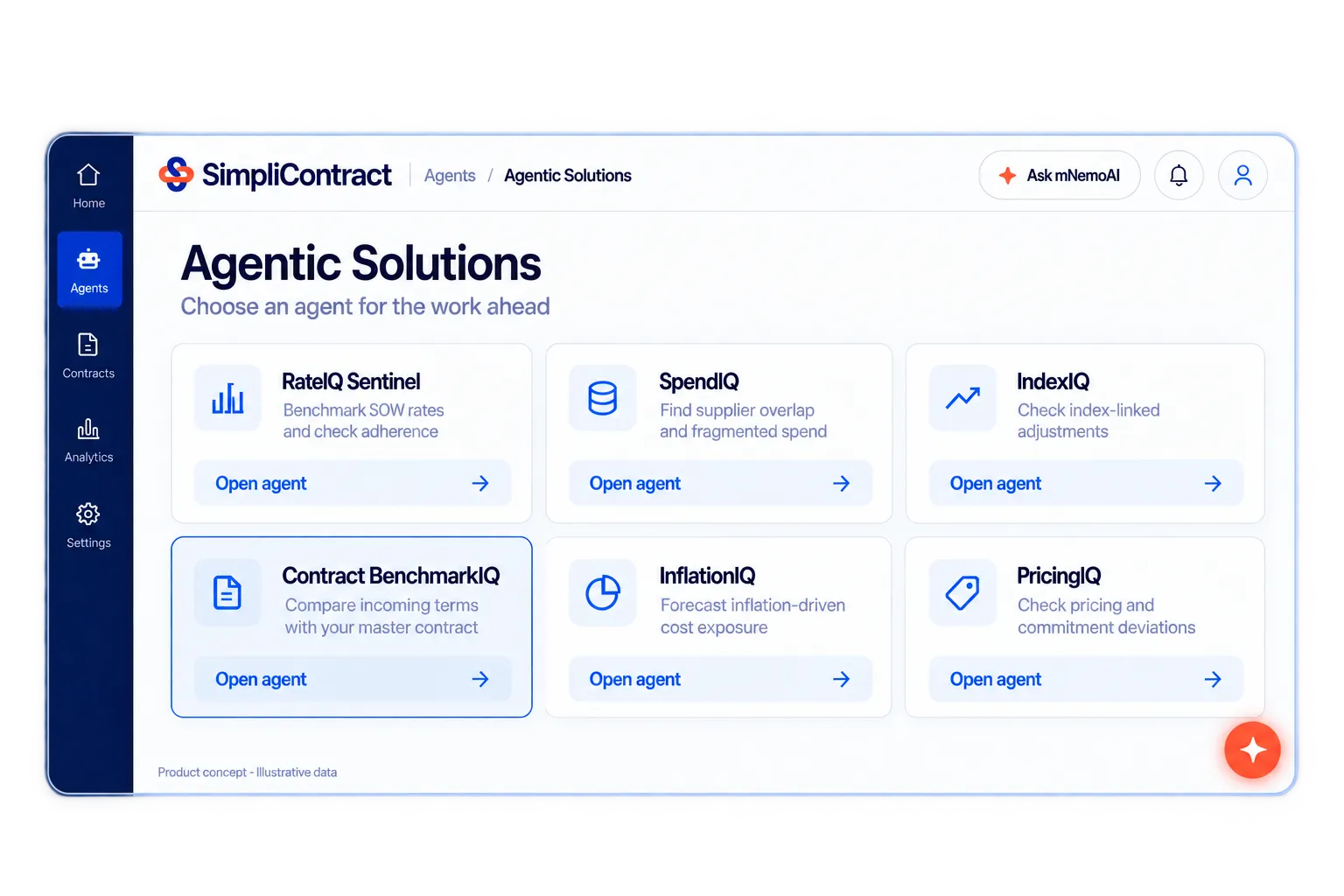
AI agents use connected contracts, supplier, spend and market data to identify coverage gaps, pricing deviations and recovery opportunities. Teams review the evidence and govern the action.
Explore available solutions and upcoming capabilities, each built around a defined commercial problem and the evidence it needs.
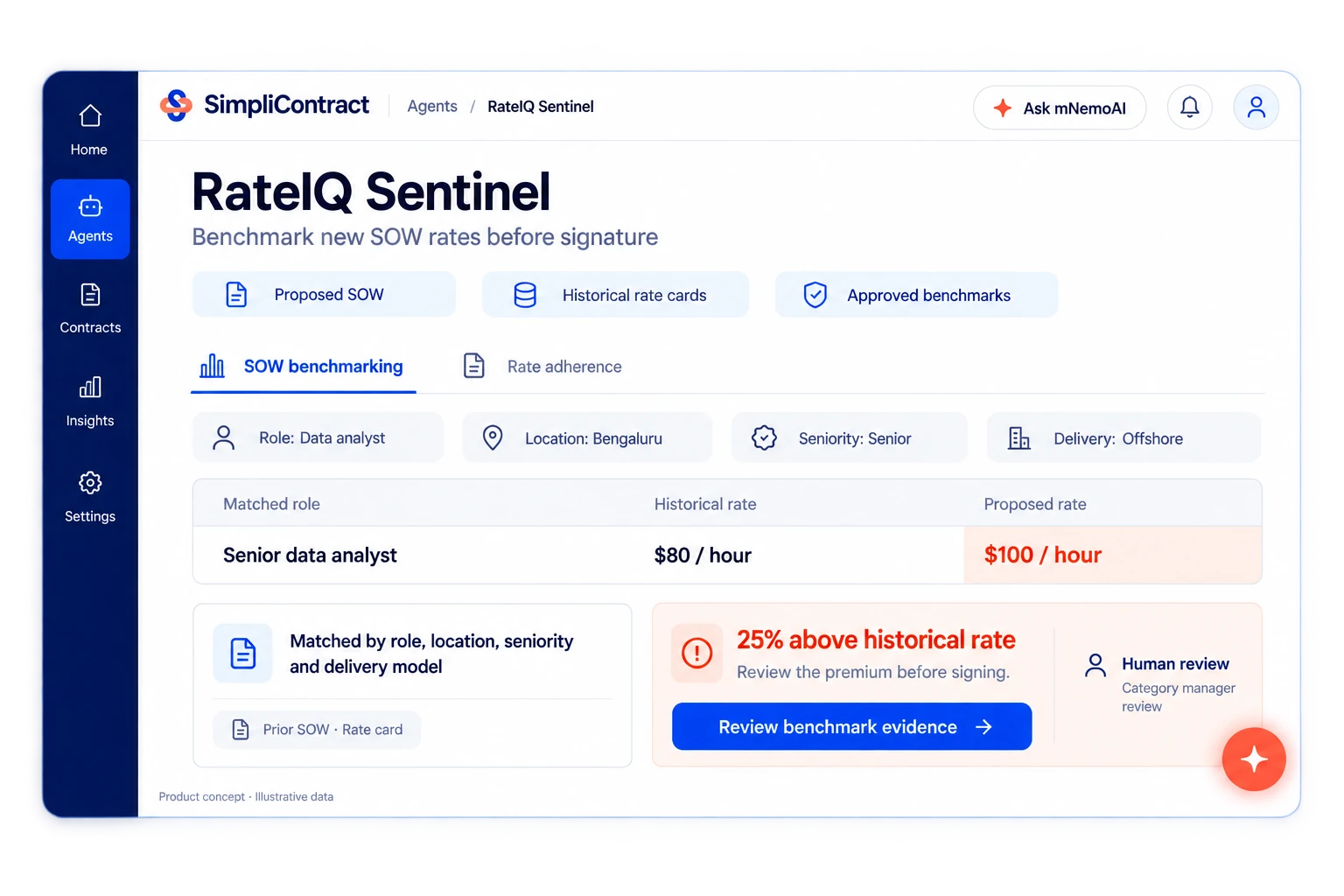
Check rate card adherence and benchmark new statements of work before signature. Compare supplier rates with applicable contract terms, your rate history and relevant benchmarks.
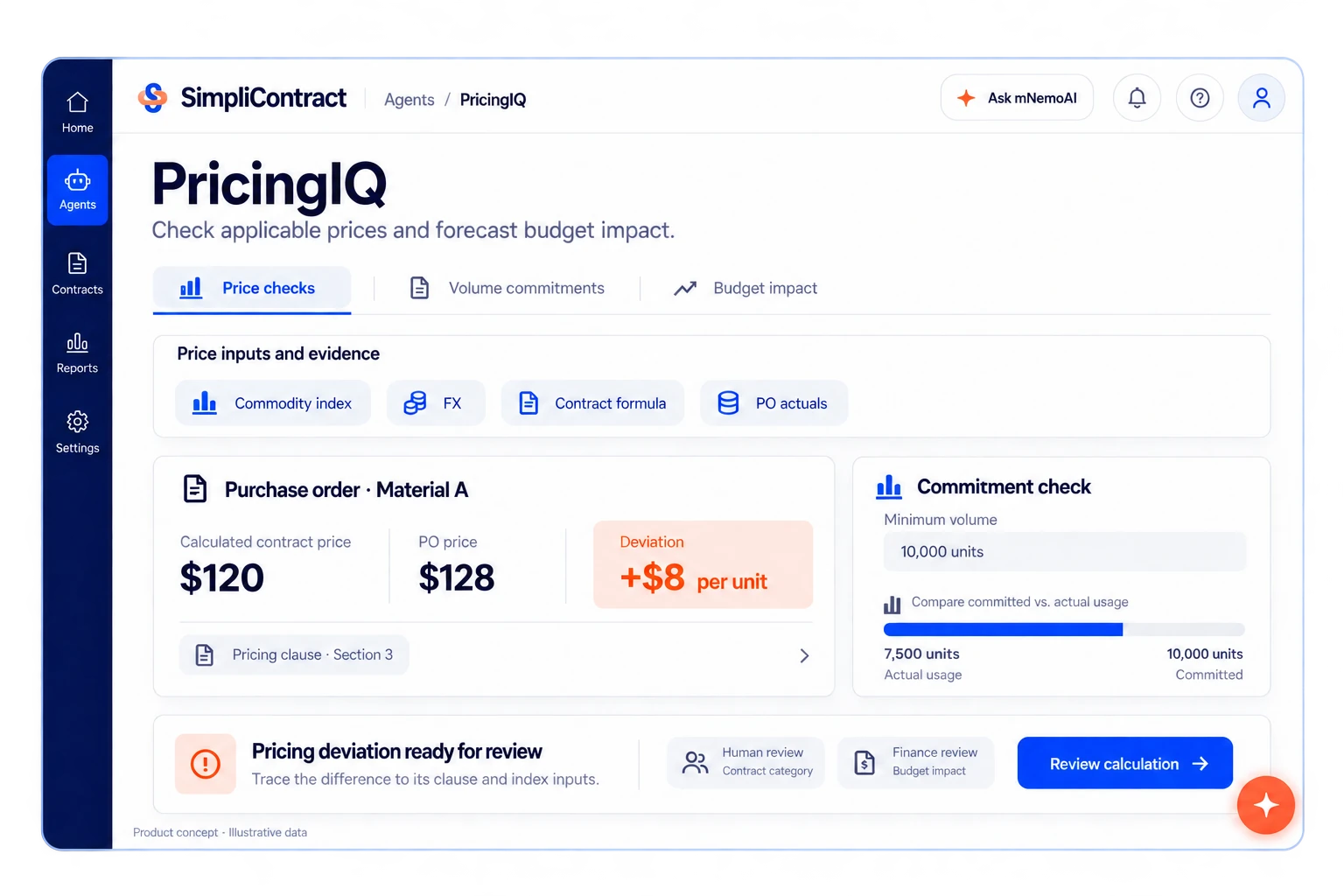
Recalculate formula-based contract prices using applicable commodity and FX indices, escalation rules and volume commitments. Flag pricing deviations and project their effect on future budgets.
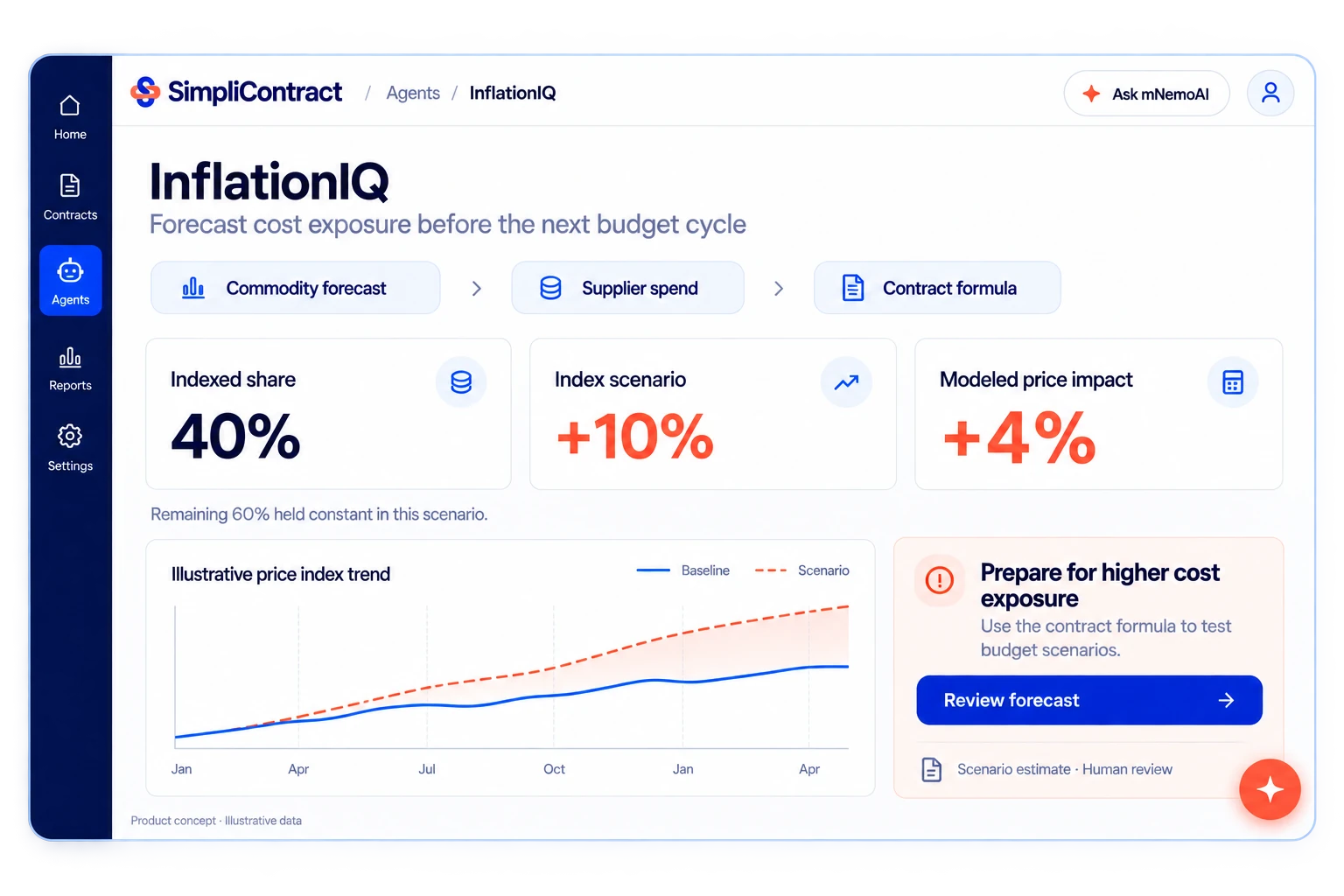
Forecast inflation-driven cost exposure by connecting market signals with contracts, supplier spend and pricing context. Help teams prepare for budget changes and renegotiations.
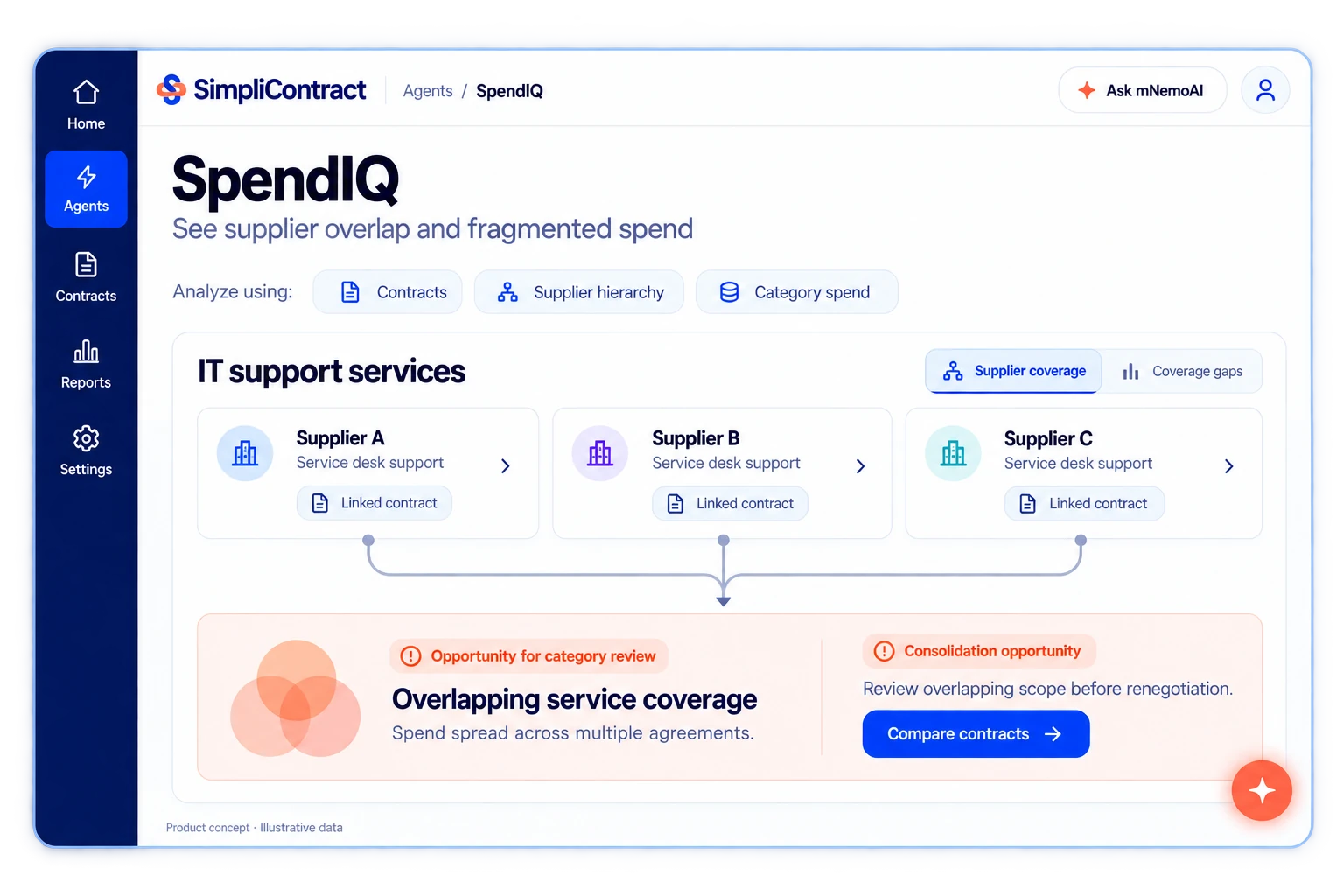
Map supplier and category spend to governing contracts. Find uncovered spend, overlapping supplier coverage and tail-spend fragmentation.
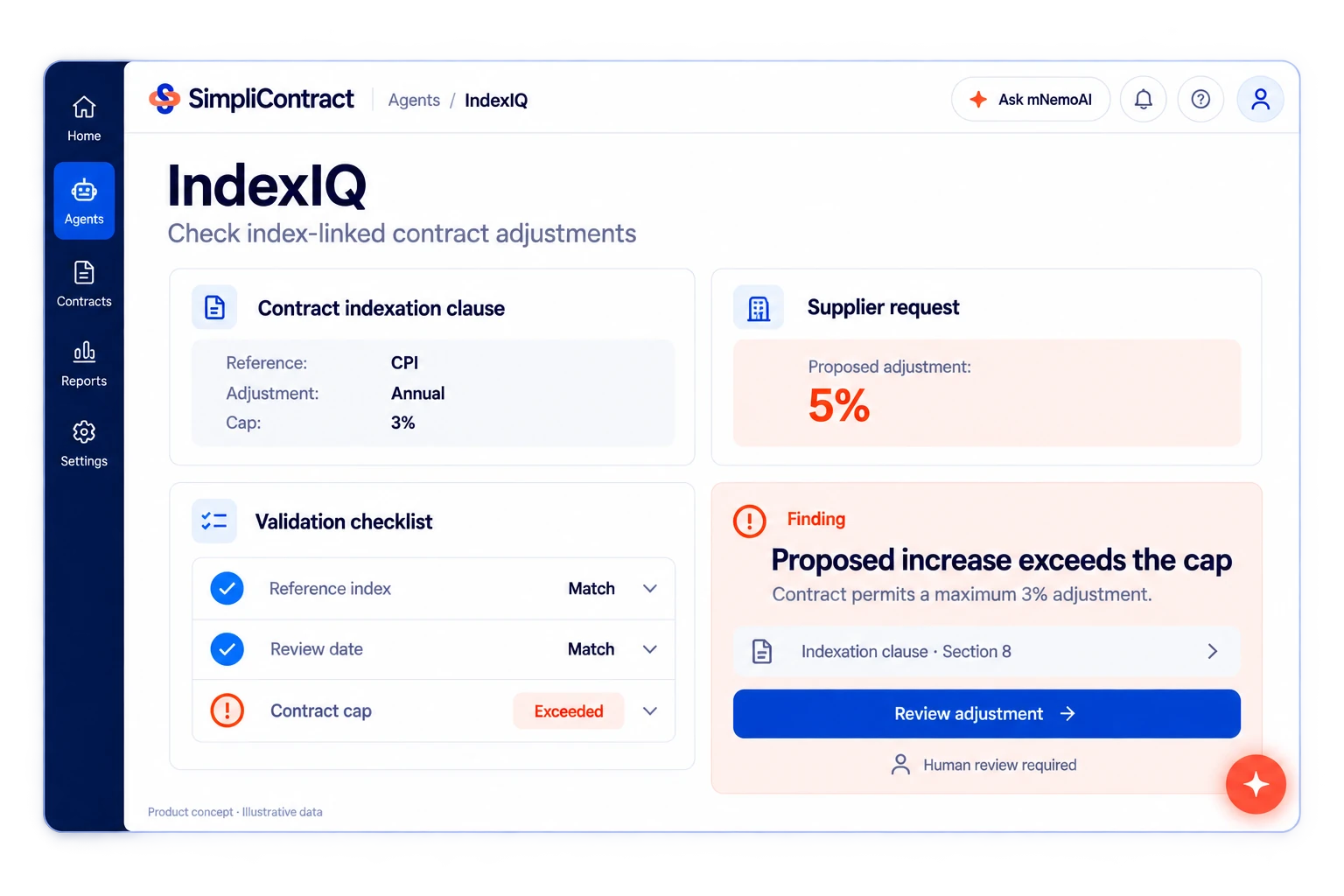
Validate contract indexation against the governing clause: index, base period, formula, timing, caps, floors and notice conditions.
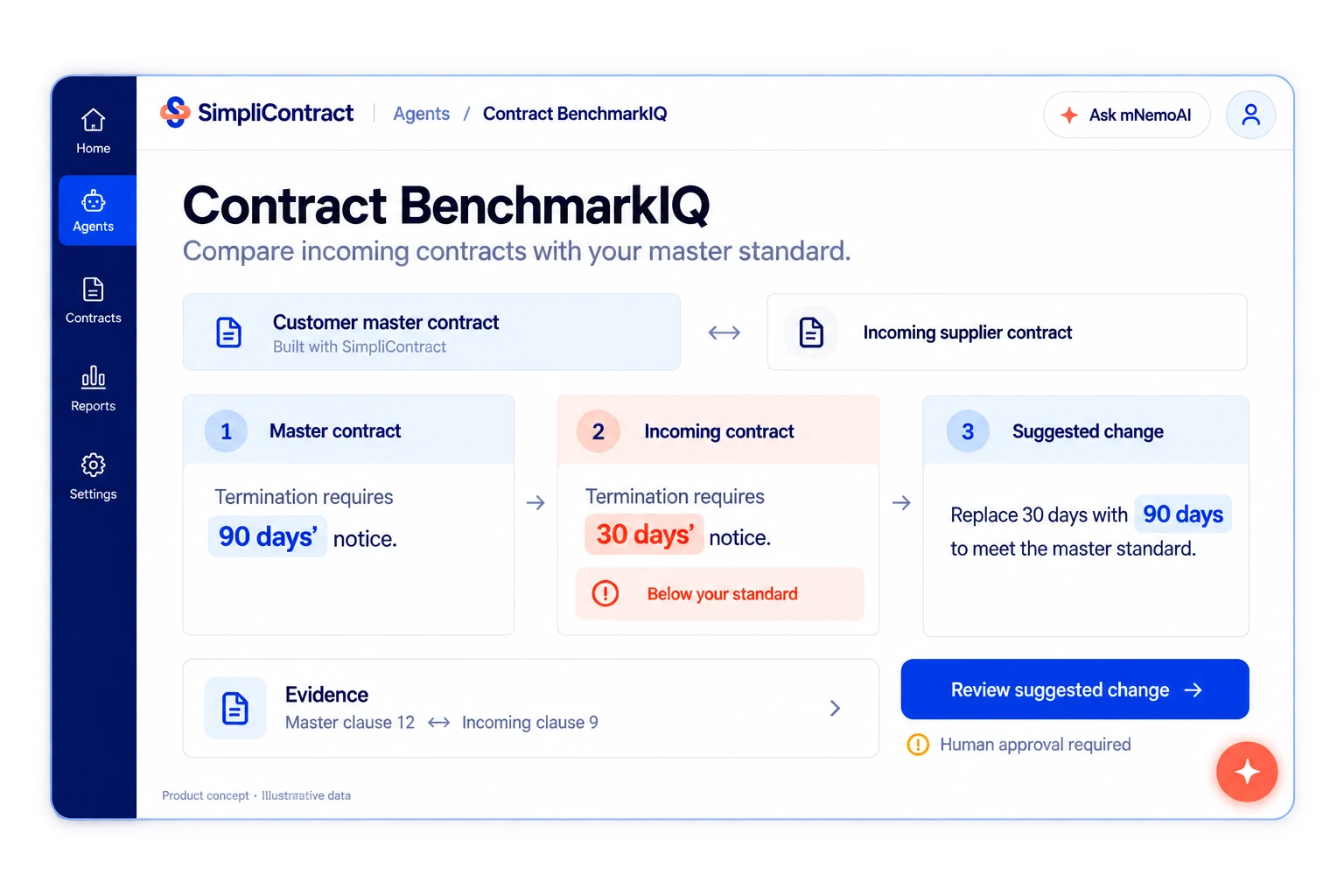
Compare contract language with your approved clauses, playbooks and fallback positions to identify deviations that need review.
Every agentic solution follows the same governed loop, so each new agent builds on the same connected foundation.
Agents monitor extracted terms such as pricing formulas, rebate thresholds, rate cards and obligations against live spend and market data.
Resolve the governing clause across amendments, then calculate the price, rate or entitlement that should be in effect.
Classify the exception and route it to the authority your policies assign, with the clause and the evidence attached.
People approve claims, forecast changes and renewals. The workflow then carries out the next step with a full audit trail.
Through the Model Context Protocol (MCP) and pre-built integrations, agents can connect to live ERP volumes, commodity and FX indices and organizational authority records. That is how an index move or a rebate threshold crossing can be caught before the payment run, not found in next year's audit. Connections and workflows are scoped to your deployment. See the platform, including the upcoming Copilot + Teams extension.
Agents flag opportunities for review. A flagged deviation is not realized recovery until a person confirms it.
Two workflows that run across the agent library and your contract estate.
Identify contractual rebates, discounts and service credits. Connect thresholds and obligations with spend and performance evidence, then route eligible claims for approval before the entitlement window closes.
Track renewal dates, notice windows and service obligations in the context of supplier activity. Give Sourcing, Category and Legal teams the evidence to renew, renegotiate or exit before a decision window closes.
Connect contract terms and notice periods with spend, service performance and current supplier context.
Flag approaching windows, unmet obligations and potential service-credit entitlement with the relevant clauses attached.
Owners decide whether to renew, renegotiate, exit or approve a claim. A flagged opportunity is not realized recovery.
Three illustrative scenarios show what changes when commercial terms are watched continuously instead of filed and forgotten.
A contract price is tied to a fuel index. No system compares the index with invoices, so the supplier keeps invoicing at an old rate and the difference builds up each quarter, unnoticed.
The formula is extracted at ingestion and connected to a live commodity feed. Every invoice is compared with the formula-adjusted rate before payment, deviations are flagged, and retroactive recovery can be started.
An MSA has been amended 11 times over five years. No system resolves which language prevails, invoices arrive at old rates, and cumulative value passes a board threshold without anyone seeing it.
The amendment chain is mapped and the prevailing language resolved clause by clause. Invoices are validated against current terms, and every amendment re-checks delegation of authority so the right approver sees it at the right threshold.
A volume rebate triggers at 80% of contracted annual volume. No system watches running volume, the threshold is crossed and nobody knows, so the rebate is missed.
The rebate term is connected to live purchase volume through MCP. An alert fires at 75% of the threshold, the claim workflow starts when it is crossed, and year-end reconciliation is produced automatically.
Illustrative scenarios, not customer results.
A flagged deviation or calculated entitlement is an opportunity to investigate. Realized savings or recovery requires validation and a completed commercial outcome; it should not be inferred from an alert alone.
IndexIQ focuses on whether contractual indexation follows the agreed index, timing and adjustment rules. PricingIQ applies pricing formulas and commercial commitments to calculate applicable prices and project budget impact.
Start with a defined use case, the data it needs and an accountable decision owner. Additional agents can build on the same governed commercial context.
Bring a rate card, coverage gap, pricing formula or recovery question. We’ll map the data, agent workflow and human decisions needed.